Listen to the Blog Post
Walk into a stone yard and you'll find aisle after aisle of slabs, each one more beautiful than the last. Polished white quartzite with soft gray veining. Deep black granite. Classic Carrara marble. It's easy to fall in love in the first five minutes, and just as easy to leave more uncertain than when you arrived.
That's because the most important question isn't which slab is the most beautiful. It's which material will still feel like the right choice after years of morning coffee, weeknight dinners, arts and crafts at the island, and the occasional glass of red wine left on the counter overnight.
In this guide, we compare the countertop options North Shore homeowners ask us about most, explain how finishes and edge profiles change the way a countertop looks and wears, and share how we help clients make this decision as part of the larger kitchen design.
Start With Your Household, Not the Material
Every countertop material behaves differently under use. Some can easily handle a hot pan, and others show every water spot. Some develop a softened, lived-in patina that one homeowner finds charming and another finds frustrating. If you choose a material before thinking about how your household actually uses the kitchen, you risk regretting a decision that's expensive to reverse.
That's why our selection conversations start with questions, not samples:
- Do you cook every day, or mostly on weekends?
- Do you bake and roll out dough on the counter?
- Do you have young children at home?
- Do you want to set a hot pan directly on the counter?
- Do you drink red wine, or cook often with lemon, tomato, or vinegar?
- Will water spots and fingerprints bother you?
- Do you want a surface that stays pristine, or one that wears in and develops character over time?
Marble is the clearest example of why this matters. Nearly everyone is drawn to it because it's genuinely beautiful, but it isn't the right fit for every household. You don't want to fall in love with a material, build your kitchen design around it, and realize afterward that it doesn't work for the way you live. Taking time on these questions first protects both your investment and your enjoyment of the finished kitchen.
Shopping for Natural Stone Takes Time
Natural stone countertops, including granite, quartzite, marble, and soapstone, are cut from quarried slabs, so every slab is different. You'll select the actual slabs that will become your countertops, and finding the right ones may take visits to more than one stone yard. A larger kitchen may also need more than one slab.
It's worth building that time into your schedule. When you find a slab you love, yards typically hold it for a short window, often around 48 hours, before asking for a deposit. Wait a month to decide, and that slab may be gone.
We make this step easier by working with a fabricator that also has its own showroom. Its stocked inventory lets our clients see, touch, and compare slabs in one place, and the same team that holds the slab is the one that fabricates it. Many homeowners otherwise visit stone yards on their own and then find a separate fabricator. We choose our trade partners for their reliability and their commitment to quality.
Types of Kitchen Countertop Materials Compared
Granite: Quietly Durable
Granite remains one of the most practical countertop materials available. It's tough, highly heat-resistant, and close to maintenance-free when it's periodically sealed. Sealing matters because of porosity: like all natural stone, granite has tiny pores that can absorb liquids, and a good sealer keeps spills on the surface long enough to wipe away. Porosity varies from slab to slab, and lighter granites tend to be more porous than dark ones.
Bakers appreciate it, too: it stays cool to the touch, which helps when working with pastry and dough.
Granite does have a few limitations. Some homeowners think certain granite patterns can look dated, and there are very few white options. If you want a white countertop, you'll likely be looking at quartz or quartzite instead. On the other hand, a dark granite can give you the look of soapstone with more durability and without the patina.
That's exactly the choice of our clients made in a remodel of an older home in Hamilton. She loved the classic look of dark soapstone, but wanted a material that could hold up to use. To get the same look as soapstone she chose a dark granite in a leathered finish. It suits the age of the house while delivering the durability of granite countertops.
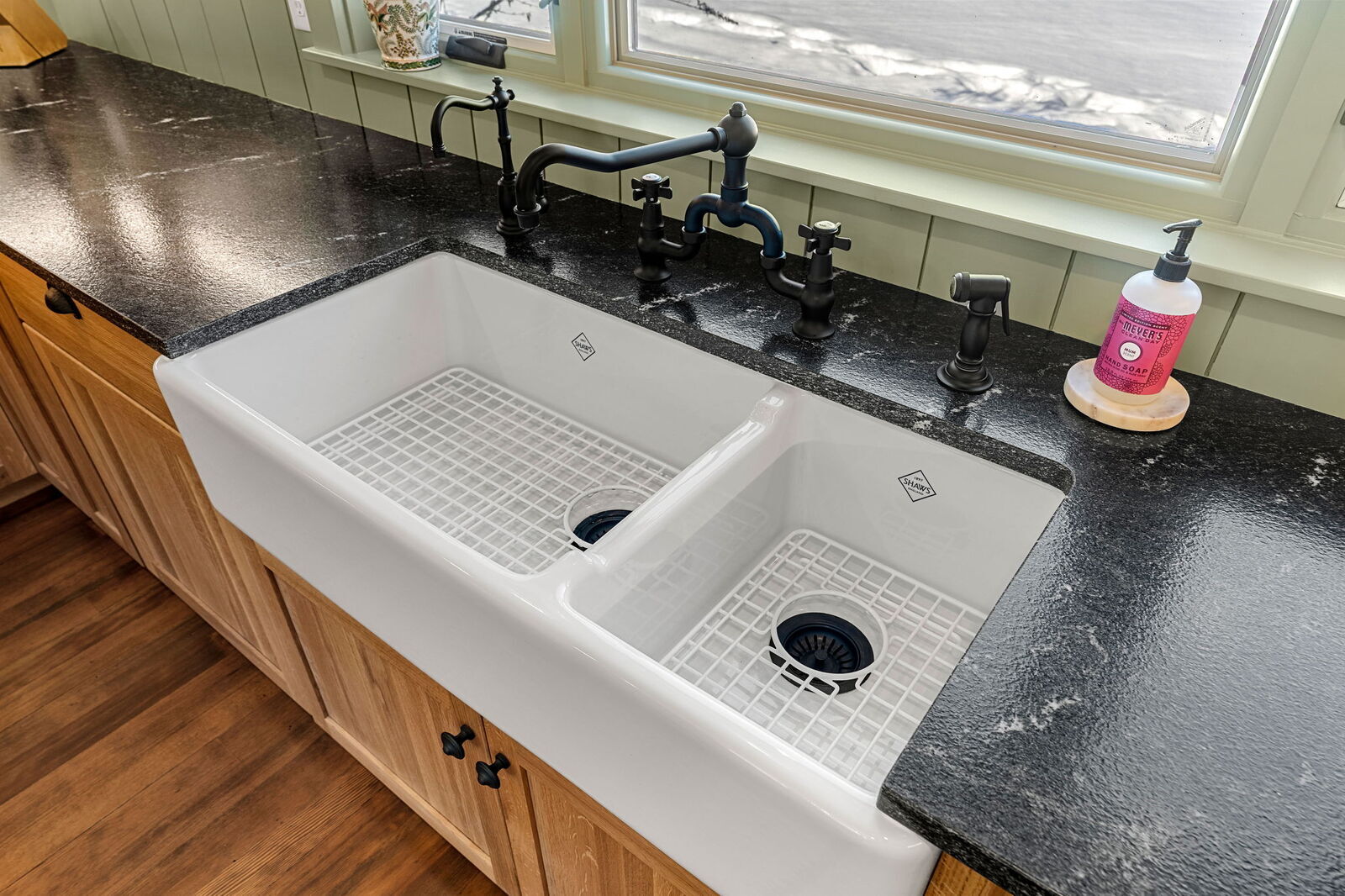 Image Above: Leathered dark granite gives this South Hamilton kitchen the classic look of soapstone, without the patina.
Quartz: Consistent and Low-Maintenance
Quartz is an engineered stone made from crushed natural stone bound with resin. Because quartz is manufactured, slabs are far more consistent than natural stone, especially in solid and speckled designs. Marble-look quartz with bold veining does vary from slab to slab, so for those designs it’s worth seeing the slabs before fabrication. Fabricators can also use remnant pieces, which means a smaller project doesn't always require purchasing a full slab.
That resin is also the source of quartz's greatest strength. It makes the surface non-porous, so quartz does not need to be sealed, and coffee, wine, and cooking oil wipe away rather than soaking in. Quartz is one of the most stain-resistant countertop materials available, which makes it a practical choice for busy households.
Heat, however, is a significant drawback. The same resin that keeps quartz stain-resistant can't tolerate high temperatures. A hot pan set directly on the surface can scorch, discolor, or even crack it, and that kind of damage is difficult to repair. If you're used to moving pots straight from the stove to the counter, plan on using trivets, or consider natural stone like granite, quartzite, or soapstone instead. Quartz can also have a manufactured appearance, and lower-quality brands sometimes look as though stone has been printed onto the surface.
Not all quartz is equal. There are many brands and quality levels on the market, which is why we're selective about where our stone comes from. Whatever you choose, work with a reputable stone yard and fabricator.
Quartzite: The Marble Look With Stone Toughness
Quartz and quartzite are easy to confuse, but they're very different materials. Quartz is engineered while quartzite is 100% natural stone, formed from sandstone under intense heat and pressure, so every slab has its own unique organic veining and color.
Quartzite is harder than granite, resists scratching and chipping, and it handles hot pans without the scorching risk of resin-based engineered quartz. It also won't yellow or fade in direct sunlight. Most of all, it offers the look of marble with better durability, which is why many homeowners who love marble ultimately choose quartzite.
It does come at a price. On average, quartzite costs more than marble, although the range within both materials is wide.
It's also important not to rely on the name alone. Stone names and categories are set by the quarries, importers, and suppliers who sell them, not confirmed by a geologist, and there's no requirement to test a slab before calling it quartzite. Because quartzite is in demand, some stones sold under that name are actually dolomite or marble, both of which formed from limestone-type rock rather than sandstone, so they etch the way marble does. Before committing to several slabs, ask your fabricator to confirm what the stone is, or bring a sample home and test it with lemon juice and vinegar.
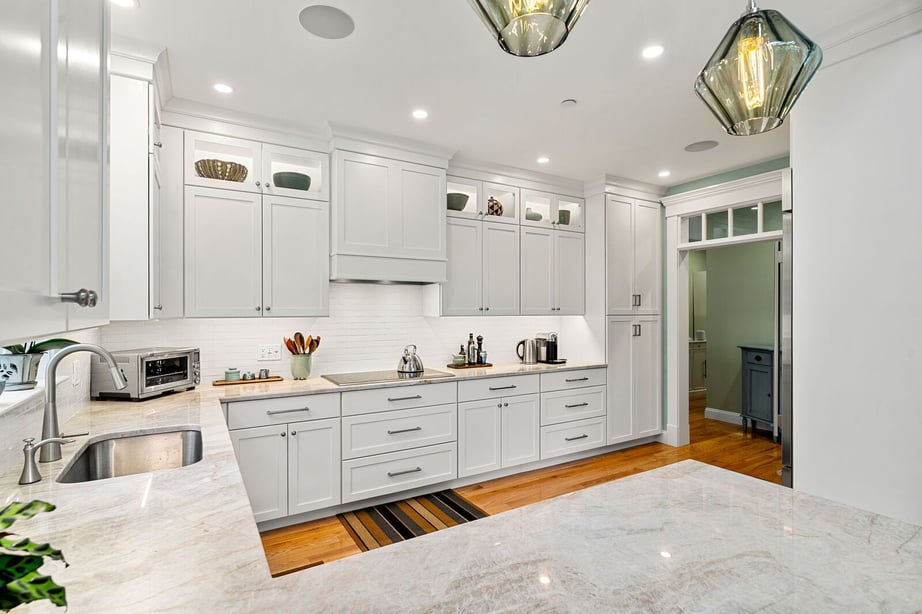 Image Above: In this Gloucester kitchen, quartzite with beige and white veining delivers the marble look homeowners love, with the toughness of natural stone.
Marble: Classic, With Character That Develops Over Time
Marble has a timeless, traditional look that feels right at home in New England, and it's a natural fit for historic homes. The two best-known varieties are Carrara, with a soft gray-white background and fine, feathery veining, and Calacatta, a brighter white marble with bold, dramatic veining that is rarer and more expensive. Marble is also the material that requires the most honesty up front.
Marble etches. Acidic foods and drinks, including lemon and lime juice, vinegar, wine, tomato sauce, ketchup, and most carbonated beverages, as well as many cleaning products, react with the stone and leave dull spots. Many homeowners are surprised to learn that sealing doesn't prevent etching. Sealing helps resist stains, but etching is a chemical reaction on the surface. Marble is also softer than granite, quartzite, and quartz, so it can scratch and chip easily.
The homeowners who are happiest with marble embrace those marks as patina, the softened character natural stone develops with use. A honed or leathered finish helps etching blend in, while polished marble shows it most. Many homeowners love the look of marble countertops without the maintenance, and that's often where quartzite enters the conversation.
We've used marble beautifully in bathrooms, where it sees far fewer acidic spills. One whole-home project features Carrara marble in a bathroom, and another bathroom is finished entirely in marble with a small ogee edge.
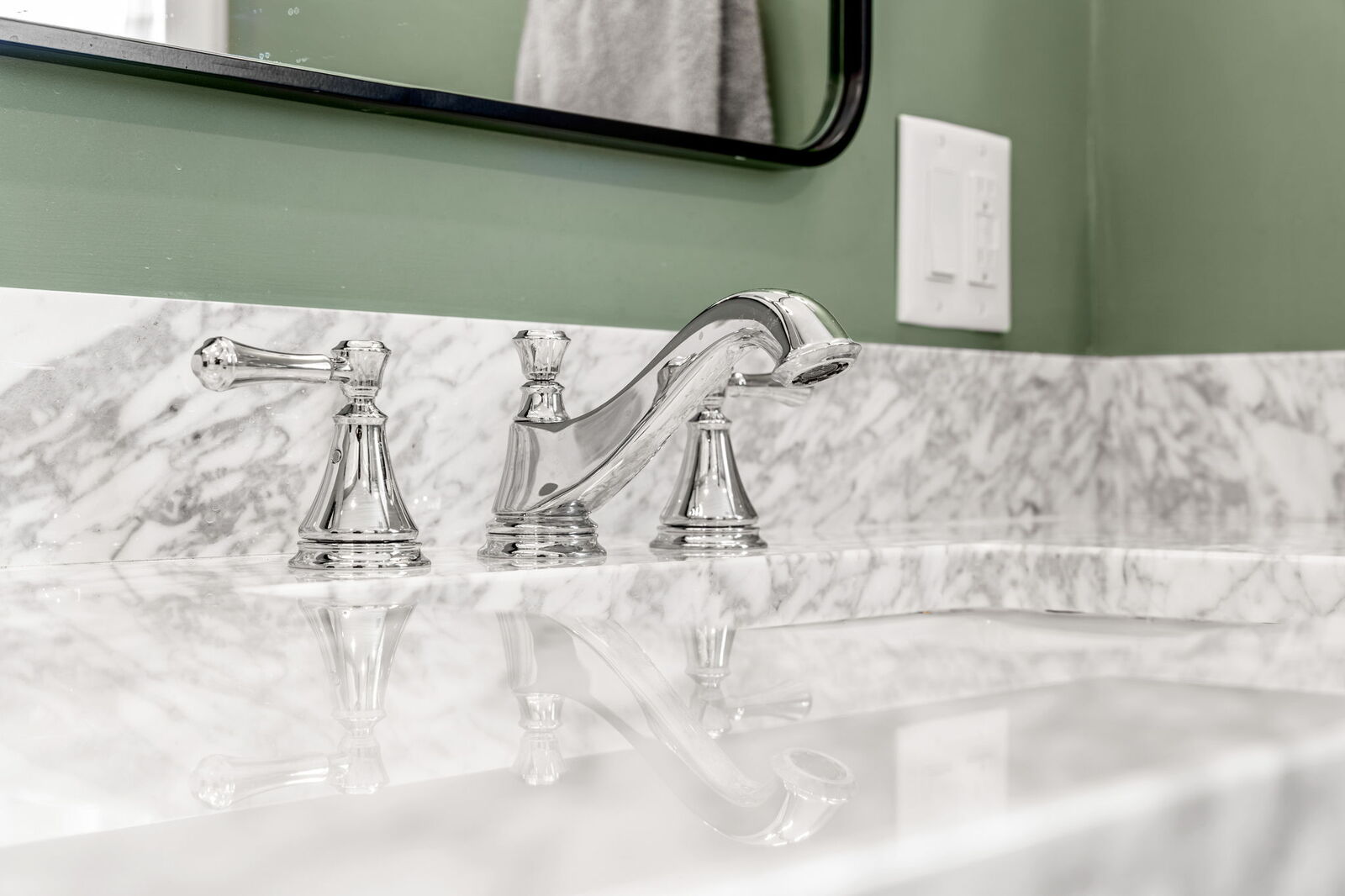 Image above: Carrara marble brings classic soft gray veining to a bathroom vanity, where it sees far fewer acidic spills than a busy kitchen.
Soapstone Countertops: Made for Patina
Soapstone is a classic New England material and a natural choice for older and historic homes. It comes in shades ranging from green to gray to nearly black, which is another reason you'll want to select your slab in person. It also patinas by darkening over time.
Soapstone handles heat well, but it's soft, even softer than marble. It nicks and scratches, although minor marks can be sanded out. Choosing soapstone means wanting the patina. If you'd prefer a surface that looks the same in 10 years as it does today, soapstone probably isn't the right choice. Soapstone is generally more affordable than quartzite and marble.
Soapstone also works well as an accent. In one whole-home remodel, the homeowners chose quartzite for their main kitchen countertops and used a dark soapstone in two smaller spaces, the coffee bar and the laundry room. That gave them the rich, dark character they wanted without relying on a softer material for the surfaces that see the heaviest daily use.
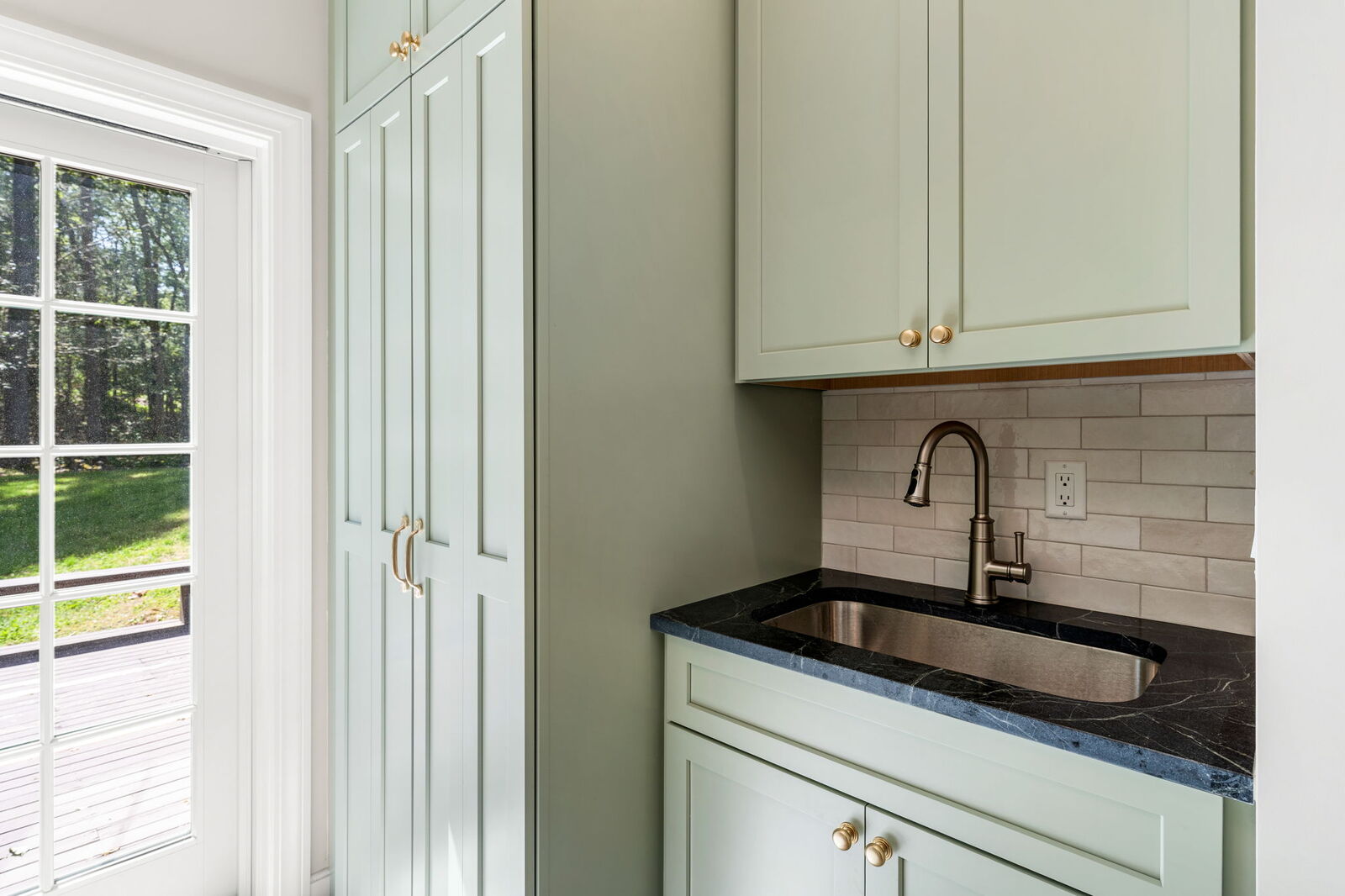 Image above: In this Essex whole-home remodel, dark soapstone in the laundry room adds depth and character.
Butcher Block Countertops: A Warm Accent
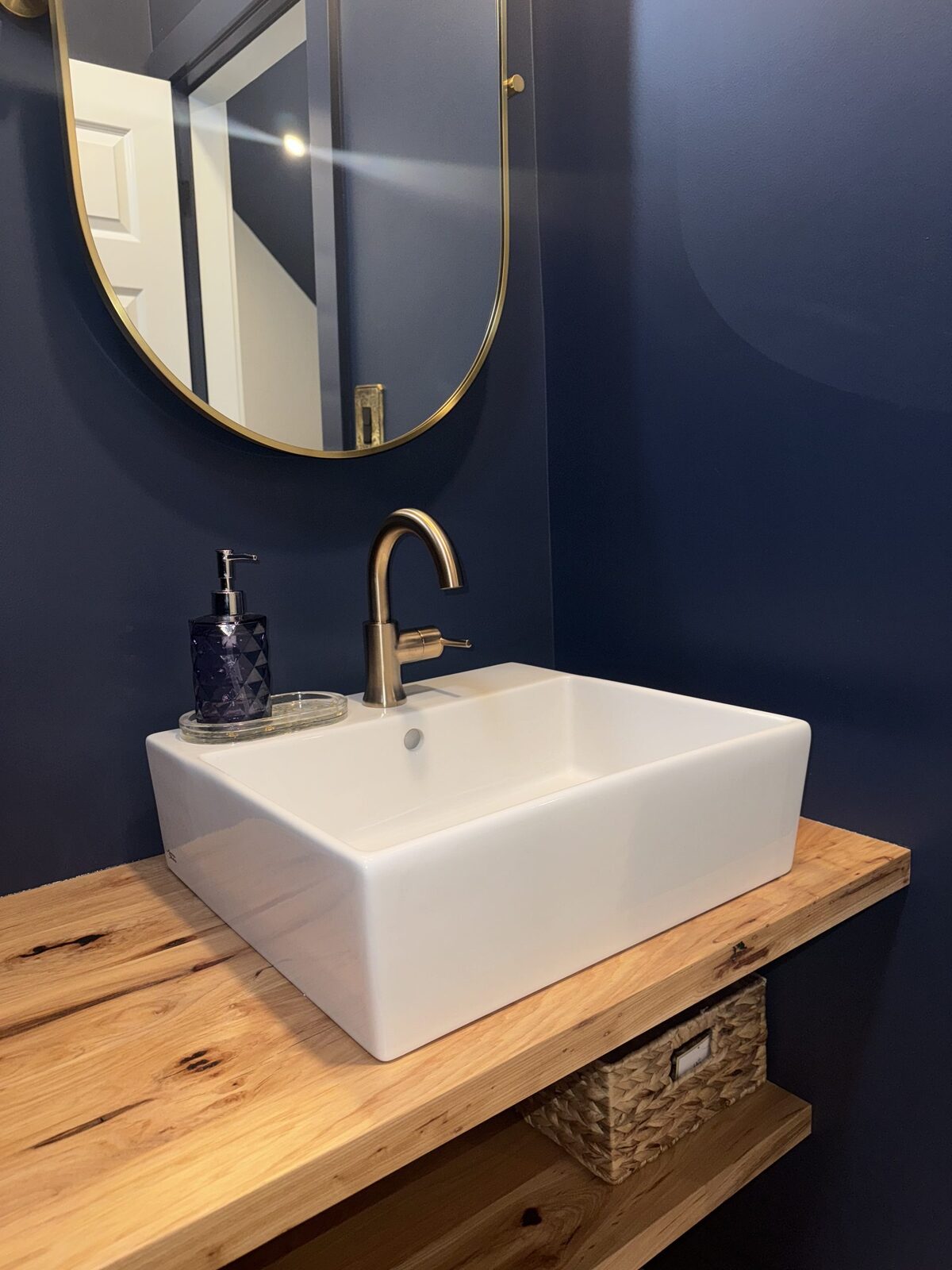
Wood countertops, most often butcher block, are rarely used for an entire kitchen. More often, it's a warm accent on a peninsula, island, coffee bar, or built-in. Wood and water don't mix well. Moisture can cause butcher block to warp or crack, so we try to keep it away from the sink. Wood also expands and contracts with New England's seasonal humidity, so it needs time to acclimate before installation and must be fastened in a way that allows for that movement.
Choosing the wood. Maple and oak are classic, durable choices, while walnut and cherry offer richer, darker tones but are softer. Construction matters, too. Edge-grain butcher block, made from long strips set side by side, is the most common and stable. End-grain, with its checkerboard look, is the most knife-friendly and the most expensive.
Oiled or sealed. An oiled finish is food-safe and can be cut on directly, but it needs regular re-oiling. A sealed finish resists water better but isn't meant to be used as a cutting surface.
Built to be renewed. Butcher block's greatest strength is that it can be repaired. Unlike stone, it can be sanded back to bare wood and refinished, removing knife marks, stains, and minor burns. Kept dry and refinished periodically, a well-made butcher block countertop can last for decades. It's also one of the more affordable countertop materials, although cost varies with the wood species and construction.
Solid Surface: A Budget-Friendly Option
Solid surface countertops, often known by the brand name Corian, are made from acrylic resin and mineral filler, with color running all the way through. Seams are nearly invisible, sinks can be molded into the countertop, and minor scratches can usually be sanded out. Solid surface is sometimes considered for islands or tighter budgets. We rarely use them because our clients tend to prefer other materials. Solid surface is vulnerable to heat and can scorch, melt, warp, or discolor under a hot pan. It also scratches more easily than quartz or granite, can be damaged by harsh chemicals, and lacks the depth and variation of natural stone.
Polished, Honed, or Leathered? Choosing a Finish
The same slab can look and wear very differently depending on how its surface is finished. Most stone countertops come in three main finishes.
- Polished: glossy and reflective, with the deepest color and sharpest veining. It's the most stain-resistant finish for natural stone, but it shows etching, fingerprints, and water spots more readily.
- Honed: smooth and matte, with a soft, understated look. Veining appears slightly softer and lighter. Honed surfaces help etching and everyday wear blend in, which is why many marble owners prefer them. They can be a bit more prone to staining, so sealing and prompt wipe-ups matter.
- Leathered: low-sheen with a gentle texture you can feel, created by brushing the stone along its natural grain. Colors look rich, and the texture disguises fingerprints, smudges, and etching. Crumbs can settle into the texture, so it needs a slightly more thorough wipe.
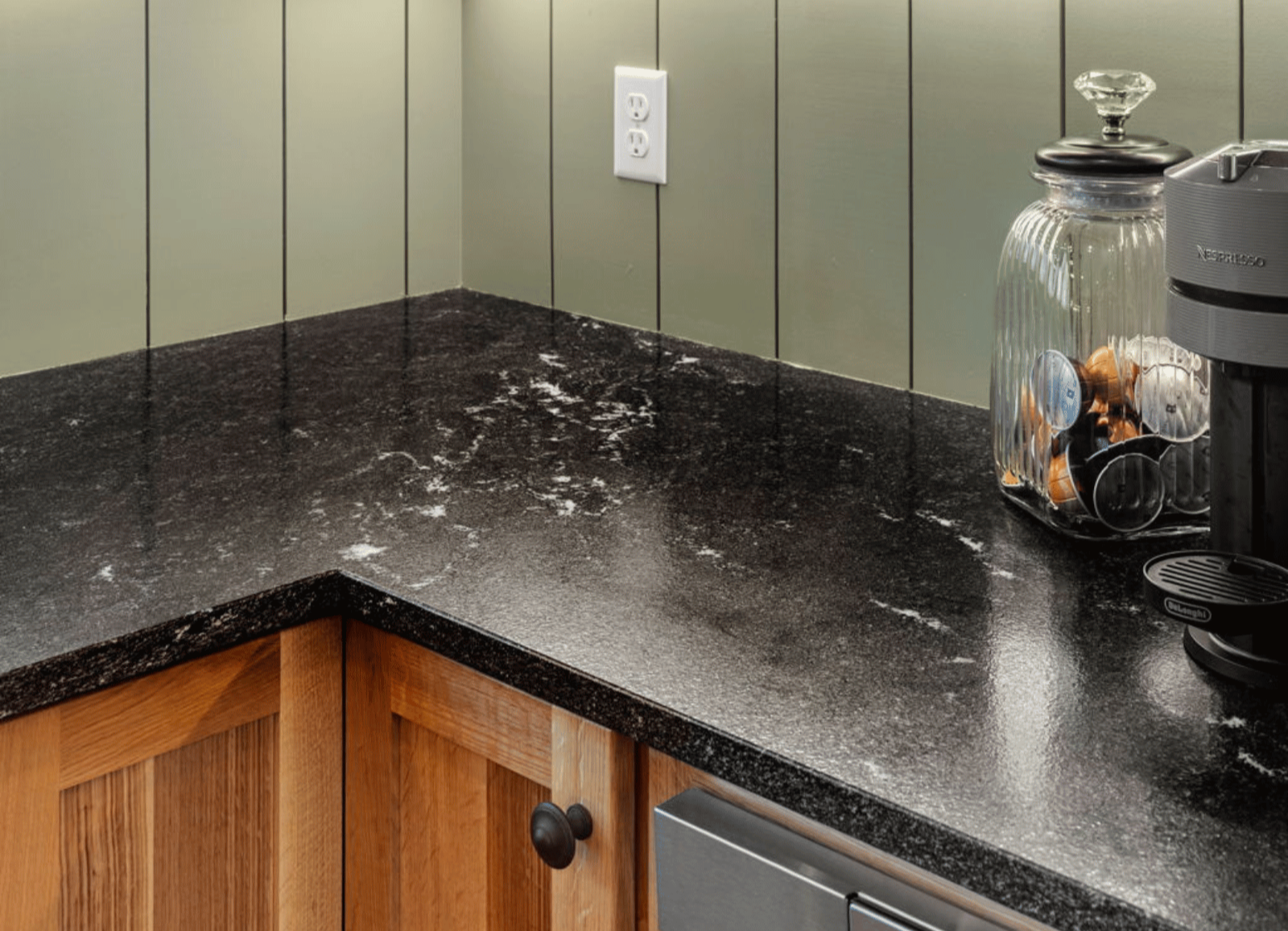 Image above: A dark black granite kitchen countertop in a leathered finish.
How Finish Works With Each Material
- Granite and quartzite: all three finishes work well. A honed or leathered granite feels more current than a high-gloss polish.
- Marble: honed or leathered for most working kitchens, since polished marble makes every etch mark easy to see.
- Soapstone: always honed. It naturally darkens to a soft matte patina over time.
- Quartz: polished is standard, and matte options are available. Ask to see a sample in person before committing.
One caution: a matte finish on a dark stone can show water spots more than you'd expect. A honed black granite delivers a beautiful soapstone-like look, but if water spots will bother you, a leathered finish is often the better choice. The texture helps hide them, and with granite, you keep all of its durability. The South Hamilton homeowner chose a leathered finish on her dark granite simply because she loved how it looks and feels, and the texture has the added benefit of forgiving everyday use.
You may also hear about brushed, flamed, or other textured finishes. These are mostly used outdoors or on floors and are rarely the right choice for an indoor kitchen.
Our advice: look at finish samples in your own kitchen's light, and run your hand across them. A finish that looks perfect in a showroom can read very differently next to your windows and cabinetry.
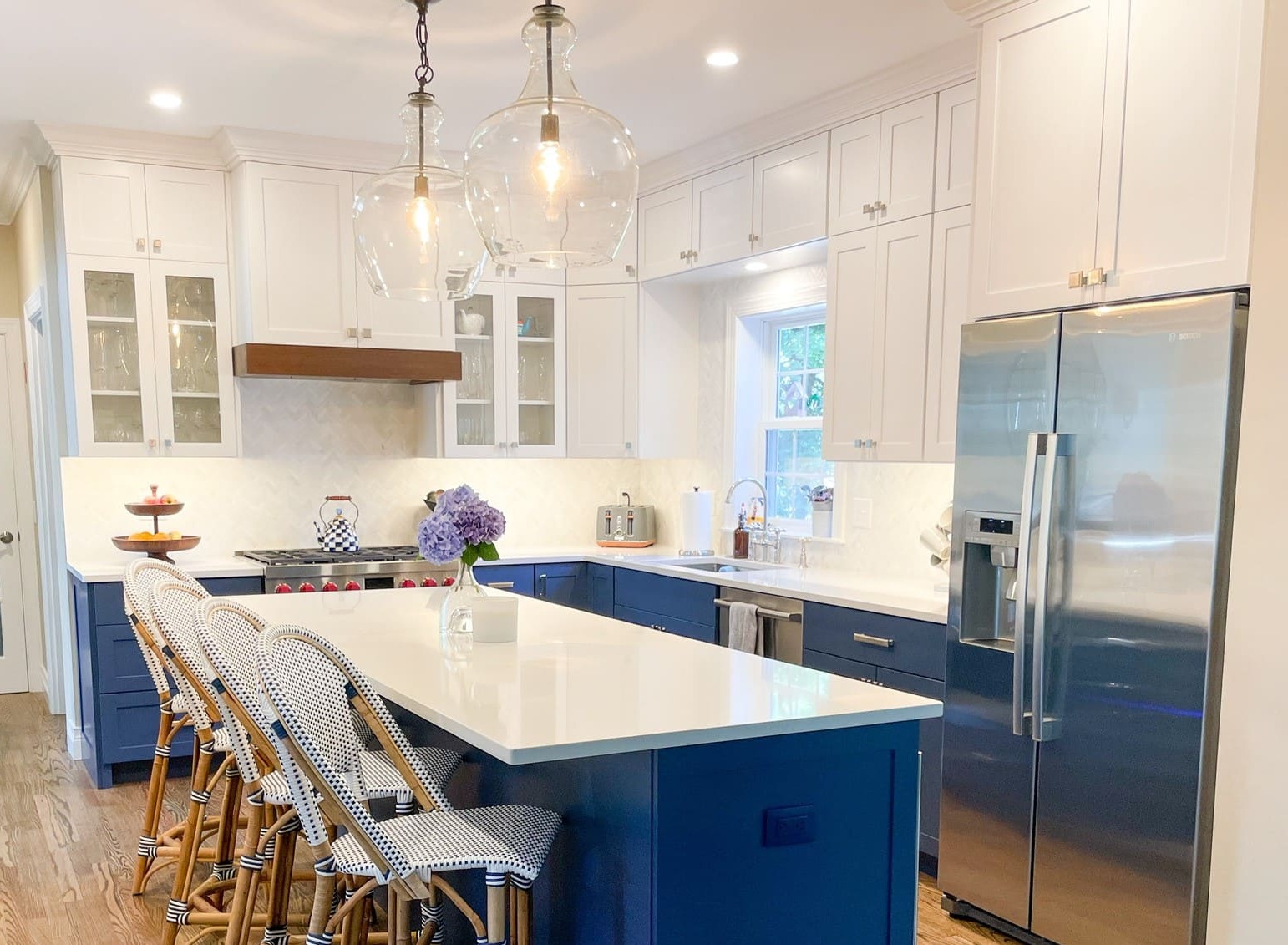
Choosing an Edge Profile
Many homeowners feel the decision is finished once they've chosen a material. Then comes one more: the edge profile, the shape cut into the exposed edge of the countertop. You touch it every day, it catches the light, and it does a surprising amount to set the style of the kitchen.
Most of our clients choose a straight polished edge, a clean profile with lightly softened corners that you may also hear called an eased or pencil edge. It's simple, easy to clean, and works in almost any kitchen. But it's far from the only option.
The Most Popular Edge Types
The illustration below shows 15 common profiles from the side.
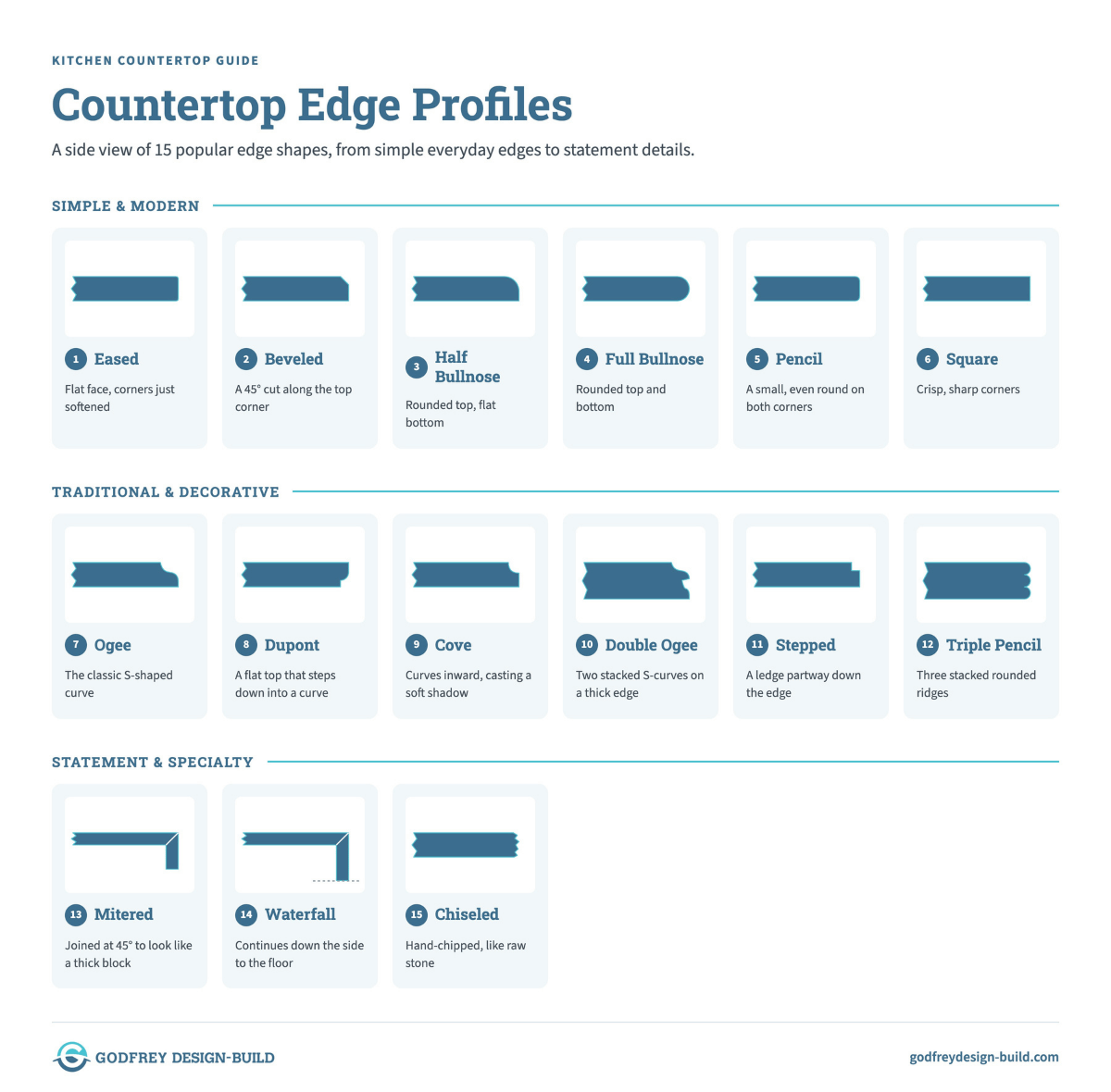 Simple and Modern Edges
These are usually included in the base price or add a small cost.
- Eased: a flat face with the corners slightly softened. Works in almost any kitchen.
- Beveled: the top corner is cut at an angle, which catches the light.
- Half bullnose: rounded on top and flat underneath. Comfortable to lean on.
- Full bullnose: rounded top and bottom, the softest edge available.
- Pencil: a small, even rounding on both corners.
- Square: crisp and sharp-cornered, for a very modern look.
Traditional and Decorative Edges
These require more fabrication and generally cost more.
- Ogee: the classic S-shaped curve.
- Dupont: a flat top that steps down into a curve, a quieter take on the ogee.
- Cove: curves inward and creates a soft shadow line.
- Double ogee, stepped, and triple pencil: layered profiles for formal kitchens.
Statement Edges
- Mitered: two pieces joined at an angle so the countertop looks like a thick, solid block. It's a high-end detail found in many luxury kitchens.
- Waterfall: a mitered countertop that continues down the side of an island to the floor.
- Natural or chiseled: a distressed edge that looks like raw, unfinished stone.
Why Homeowners Choose Different Edges
Most edge decisions come down to four considerations:
- Safety: rounded edges are kinder to young children and to hips at counter height.
- Style: the edge sets the kitchen's tone, from sleek to traditional.
- Upkeep: some profiles are far easier to wipe clean than others.
- Investment: the more complex the edge, the more it costs to fabricate, and that cost adds up across every linear foot of a kitchen.
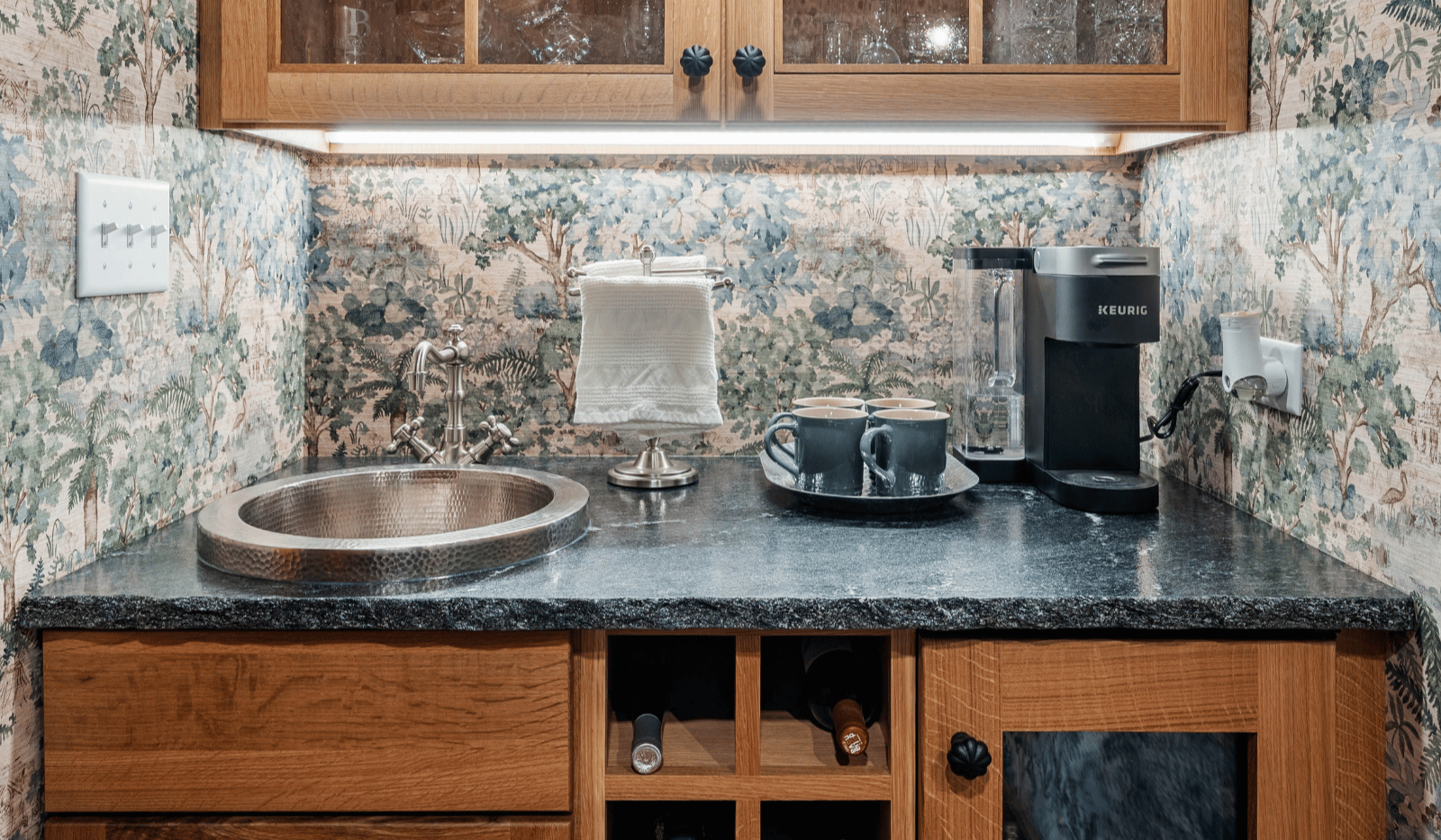
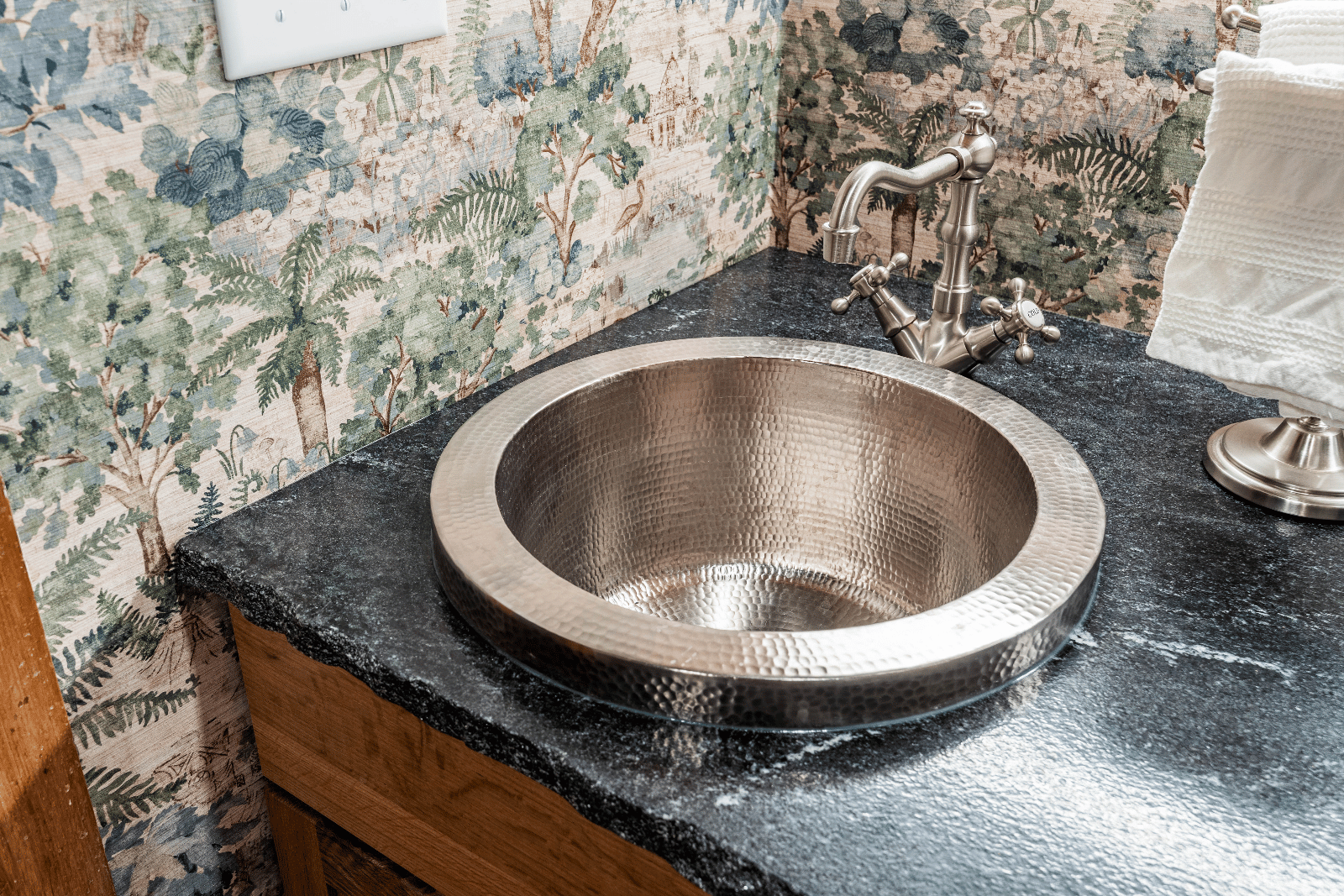 Image above: In this South Hamilton butler’s pantry, a natural, chiseled edge gives the granite the look of raw stone, a striking detail for a space that sees less daily wear than the main kitchen.
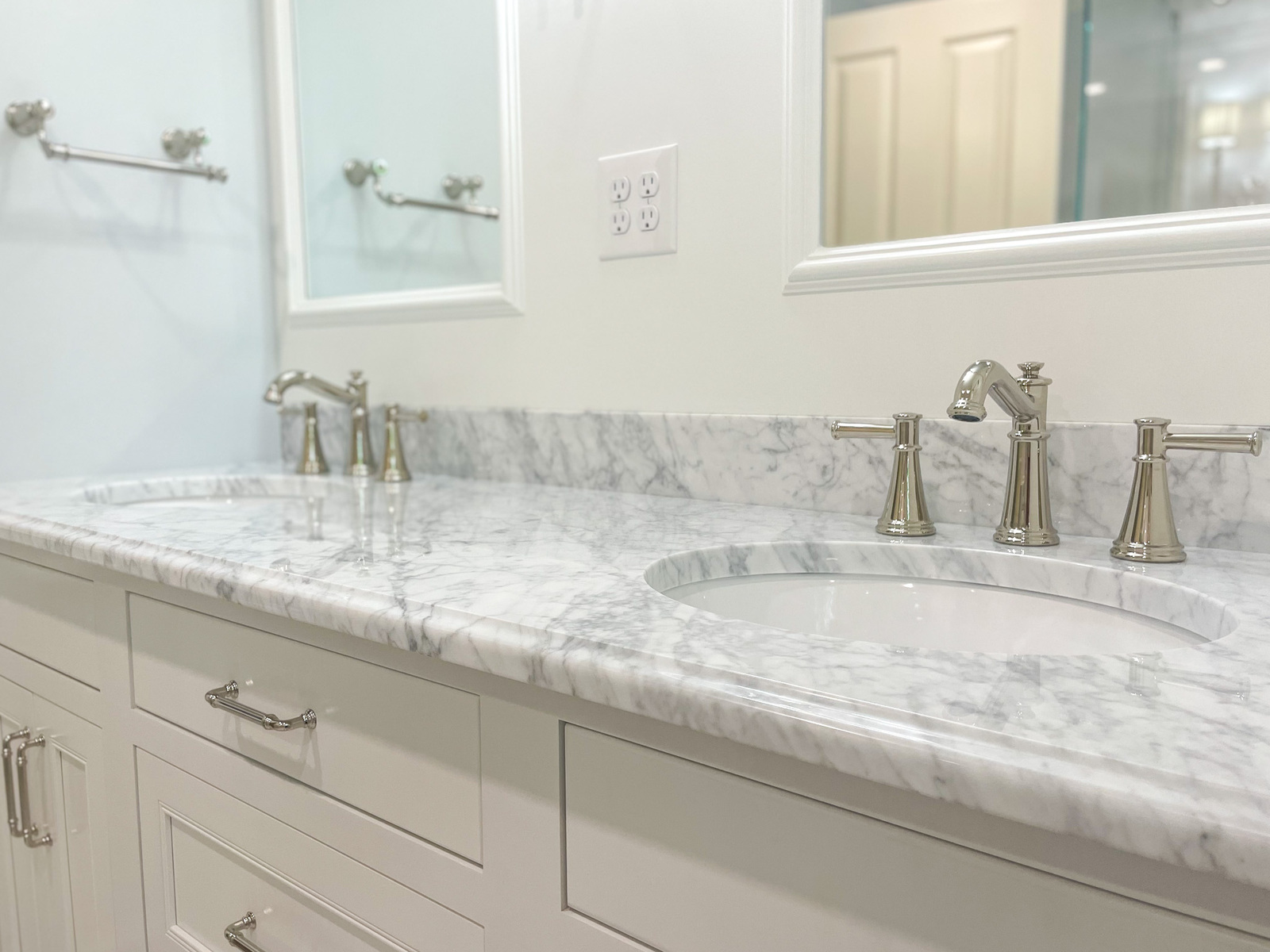 Image above: This vanity pairs gray-veined marble with a small decorative ogee edge.
Match the Edge to the Cabinet Style
The simplest guideline is to let the cabinetry lead.
- Shaker and flat-panel cabinets pair naturally with eased, beveled, or pencil edges.
- Raised-panel, beaded-inset, or other traditional cabinets carry the visual weight of a bullnose, ogee, or dupont edge.
In many older North Shore homes, the edge profile is a subtle way to echo the original millwork, helping even a modern kitchen feel as though it belongs in the house.
Durability and Cleaning
Simple edges are the most durable. Eased and beveled profiles leave the least thin stone exposed to chipping, and a single pass of a cloth cleans them. Ornate profiles like ogee and Dupont have delicate points that can chip if struck by a heavy pot, and their inward curves collect crumbs and dust.
Space is worth considering, too. A profile like an ogee curves away from the top surface, so in a smaller kitchen it slightly reduces the usable countertop. It isn't much, but in a tight layout every inch counts.
Material and Thickness Limit Your Options
Not every edge works with every countertop.
- Granite and quartzite take almost any profile well because they're dense and hard.
- Marble and soapstone are softer and look most refined with simpler edges.
- Quartz manufacturers often specify which profiles they approve for each product line.
- Thickness matters. Deep, ornate profiles need enough stone to look right. On a thinner slab, a dramatic edge usually means building up the front with a second strip of stone, which adds cost and a seam line.
The best time to choose the edge is when you choose the slab, not afterward. Seeing edge samples in person at the stone yard, where you can touch them and compare them side by side, makes the decision much easier.
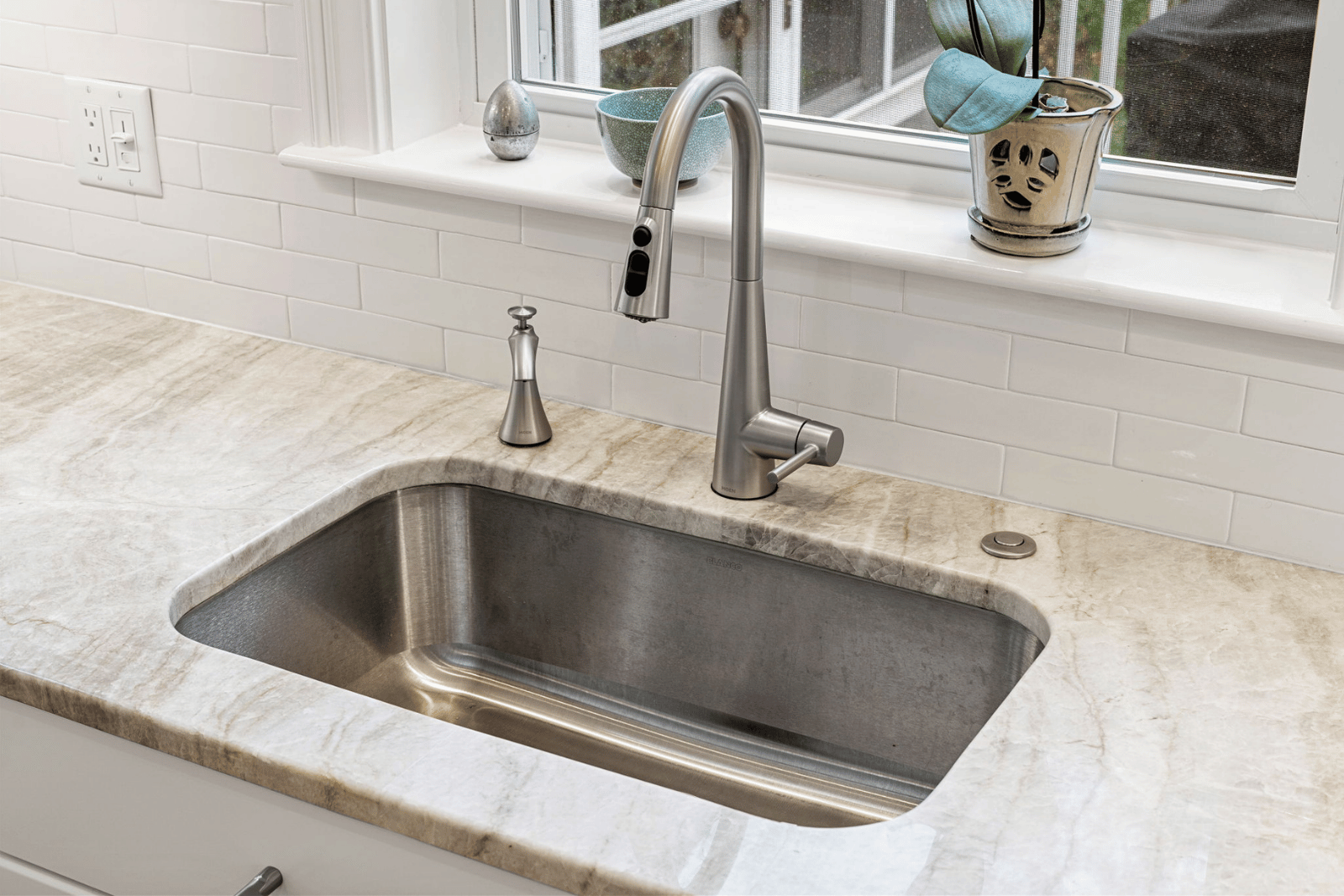
Countertops in Older North Shore Homes
Many North Shore homes were built long before granite islands and quartz waterfalls. When we remodel a kitchen in a colonial, a Victorian, or a mid-century home, we look for countertops that feel connected to the house rather than dropped into it.
Soapstone and marble have long histories in New England kitchens and feel especially at home in historic houses. Their patina is part of their appeal: a surface that softens with age suits a house that has done the same. For homeowners who love that look but want more durability, a dark granite or a marble-look quartzite can offer a similar feel with less maintenance.
Finish and edge carry that story further. A honed or leathered surface reads as quieter and more traditional than a high-gloss polish, and an edge profile that echoes the home's original millwork helps new work belong. In the South Hamilton home, dark leathered granite paired with a brick backsplash gives the kitchen a sense of history while performing like a modern surface.
For more on what to expect when the house itself is part of the design challenge, see What to Expect When Remodeling a Kitchen in an Old House.
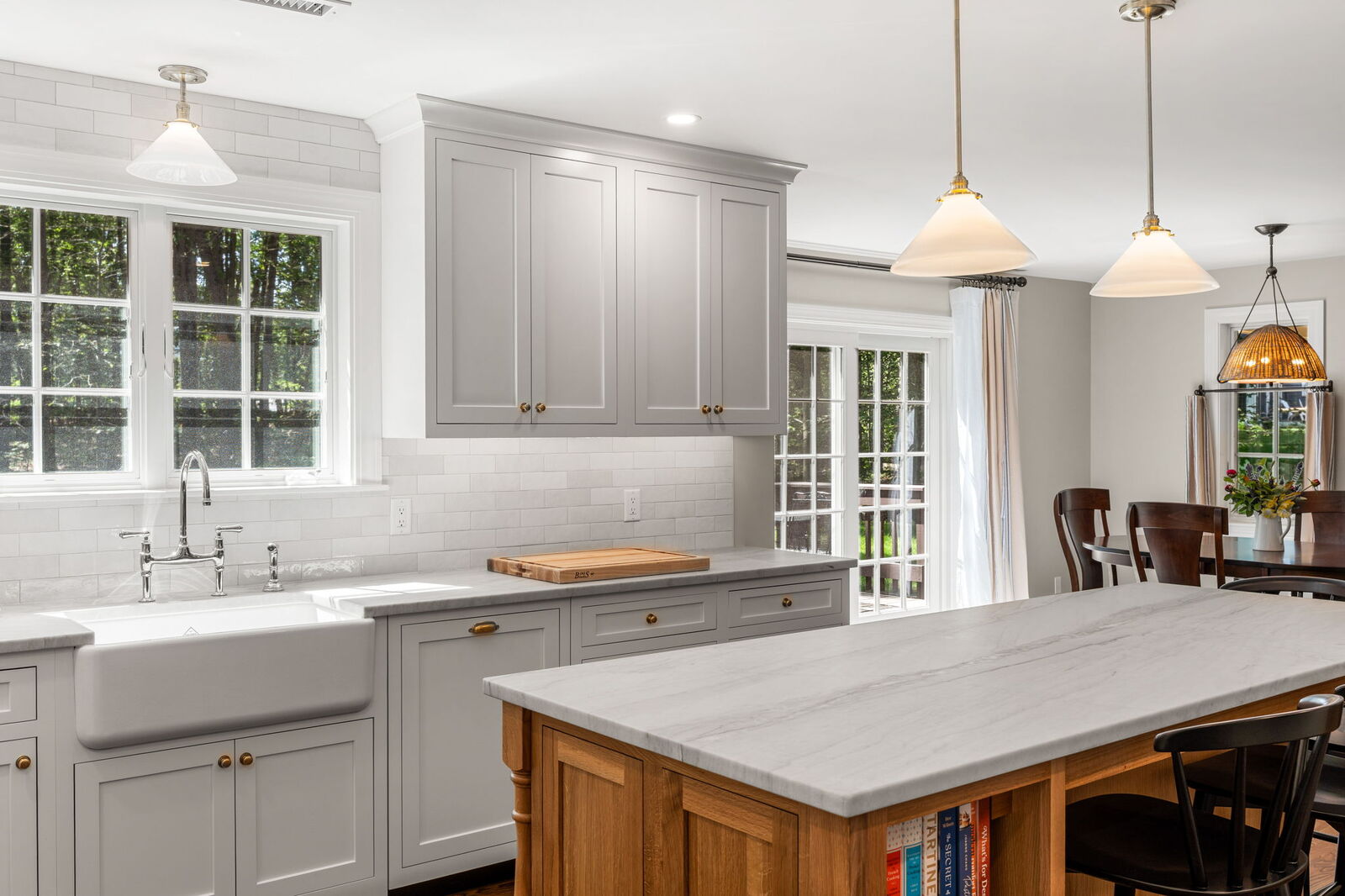
Image above: White quartzite with soft gray veining brings the look of marble to this bright, warm kitchen.
Why Countertops Belong in the Whole Kitchen Plan
Countertops are often treated as a finish selection made late in a project. In practice, they're connected to many of the decisions made much earlier.
- Cabinet support: natural stone is heavy. Cabinetry must be built to carry its weight, and large overhangs at an island may need added support.
- Sinks and faucets: undermount sinks, integrated drainboards, and faucet placement all depend on the material and how it's fabricated.
- Backsplash: the countertop and backsplash should be designed together so their colors, patterns, and textures complement each other.
- Layout: the size of the island and the seams between slabs can depend on the slab sizes available in the material you choose.
- Timeline: selecting natural stone, templating, and fabrication all take time, and that time belongs in the project schedule from the start.
Planning these pieces together is one of the advantages of a design-build approach. As we design your kitchen remodel, we consider the countertop alongside the cabinetry, plumbing, layout, and your investment range, rather than discovering a conflict once construction is underway.
For broader context on how selections affect your budget, see What Drives Kitchen Remodel Costs?
 How We Help You Decide
Choosing a countertop is one of hundreds of decisions in a kitchen remodel, and it's easier with a structured process and an experienced guide beside you. Here's how we approach it with our clients:
- We start with how you live. Before looking at a single slab, we talk through how you cook, clean, and entertain, and how much maintenance and patina you're comfortable with.
- We narrow the field. Based on those answers, your design, and your investment range, we recommend the materials worth considering and explain the trade-offs honestly.
- We select slabs together. Our fabricator's showroom lets you see, touch, and compare slabs, finishes, and edge samples in one place, and we help you evaluate them against your cabinetry and the rest of your selections.
- We coordinate every detail. The countertop is designed alongside the cabinetry, sink, backsplash, and layout, so everything fits and works together.
- One team carries it through. From design through fabrication and final installation, the same team manages your project and stands behind the result.
The goal isn't to steer you toward one material. It's to help you choose the countertop you'll still love years from now, for the way your household actually lives.
Download the Kitchen Remodeling Planning Guide
Countertops are one of many decisions that shape a successful kitchen. Our free guide, Planning a Kitchen Remodel: A Guide to Layout, Investment, and Design Decisions That Matter, will help you think through the priorities that matter most before design begins.

Start the Conversation
Narrowed it down to two materials, or not sure where to begin? That's a conversation worth having as part of your larger kitchen plan.
During an initial consultation, we'll talk through how you use your kitchen, your investment range, and your timeline, and whether our structured design-build process fits the way you prefer to work. Our approach is best suited to homeowners who value thoughtful planning and craftsmanship over the lowest bid.

Frequently Asked Questions
Is quartz or granite better for a kitchen?
Neither is better for every kitchen. Granite is natural stone that handles heat exceptionally well, offers unique variation, and needs periodic sealing. Quartz is engineered for a consistent look and very low maintenance, but it's less heat-tolerant. If you want a white countertop, quartz offers far more options than granite.
What's the difference between quartz and quartzite?
Quartz is an engineered material made from crushed stone bound with resin. Quartzite is 100% natural stone, formed from sandstone under heat and pressure. Quartzite is harder than granite, handles heat well, and offers the look of marble, while quartz offers a uniform appearance at a lower cost.
What's the most durable kitchen countertop?
Granite and quartzite are among the most durable choices. Both resist heat, scratches, and chips, and both benefit from periodic sealing. Quartz is also very durable for daily use but is more sensitive to heat.
Can you put hot pans on quartz?
It's best not to. The resin in quartz can scorch, discolor, or crack under high heat, so we recommend using trivets. If you want to set hot pans down directly, granite, quartzite, and soapstone are better options.
Is marble a bad idea for a kitchen?
Not if you choose it knowingly. Marble etches when exposed to acids, and sealing doesn't prevent it. Homeowners who are happy with marble kitchens welcome the patina it develops. If you want the look without the maintenance, quartzite is a popular alternative.
Do granite countertops need to be sealed?
Yes, granite benefits from periodic sealing to keep it resistant to stains. Once sealed, it's close to maintenance-free for everyday cleaning.
How long does countertop installation take in a remodel?
It depends largely on the material. Natural stone takes time to select, and countertops are templated only after the cabinetry is in place, followed by fabrication and installation. We build those steps into the project schedule from the beginning so the countertop never holds up the rest of the work.
What is the most popular countertop edge?
A straight polished edge, also called an eased or pencil edge, is the most common choice among our clients. It's simple, durable, easy to clean, and suits almost any kitchen style.
Which countertop edge is best for families with young children?
Rounded profiles such as a half bullnose or full bullnose are the gentlest choices for families with young children, since they have no sharp corners. A straight polished edge with softened corners is also a practical option.